ChatGPT
 Perplexity AI
 Claude
Writing a back-end developer resume shouldn't feel like debugging legacy code at 3 AM—it's actually more straightforward than you think. You just need the right framework and a clear understanding of what hiring managers are looking for.
In this complete resume guide, we'll break down everything you need to build a strong back-end developer resume. You'll find expert tips for highlighting your technical skills, real back-end developer resume samples from successful candidates, and resume templates designed to get past both ATS systems and human reviewers.


 See more examples like these
In this guide, we’ll cover everything you need to know to create a strong back-end developer resume. Keep reading and learn how to:
- Explore real back-end developer and software engineering resume examples
- Choose the right developer resume format to highlight your skills
- Write a summary or objective to elevate your back-end developer resume
- Highlight the most in-demand back-end developer hard (and soft) skills
- Create a custom projects section for your back-end resume
- Include your back-end developer courses and certificates
- Properly list your education as a young developer
- Tailor your back-end developer resume for specific job ads
- Link your GitHub in your software engineering resume
- Avoid resume mistakes back-end developers often make
- Find out how to make your cover letter and resume match
- Learn all about the average salary and job outlook for back-end developers
If you don't feel like reading and prefer watching a video instead, check out the front-end resume guide below. Most of the points it makes can be applied to your back-end developer resume, too.
Oh, and if you want to turn your LinkedIn profile into a resume with just one click, we've got you covered.
Back-end developer resume example


Why does this back-end developer resume work?
- Strong educational foundation with quantified achievements: Michael's First Class Honours from the University of Edinburgh, ranking in the top 3% of his programme, immediately establishes technical credibility critical for back-end development roles.
- Diverse and relevant tech stack: The resume showcases a well-rounded skill set spanning multiple languages (PHP, Python, Ruby, Java, Rust, C++) that demonstrates versatility across different back-end environments.
- Project delivery success: Being recognized as a top-performing employee for completing all projects within budget and on schedule speaks directly to reliability and professional execution—qualities hiring managers value.
What could be improved?
- Lacks specific technical accomplishments and metrics: The bullets are too generic. Instead of "Developed functional web applications," include specifics like "Built RESTful APIs serving 50,000+ daily requests" or "Optimized database queries reducing load time by 40%."
- Missing critical back-end technologies: The skills section lists languages but omits what recruiters scan for—databases (PostgreSQL, MongoDB), frameworks (Django, Laravel), cloud platforms (AWS), containerization (Docker), or version control (Git).
- Summary is too generic: Phrases like "dynamic and accomplished" and "profound passion" are filler words. Lead with specific technical expertise instead, such as "Back-end Developer specializing in Python and cloud architecture with 3+ years building scalable microservices."
Full Stack Developer Resume Example

Why does this full-stack developer resume work?
- Three projects with actual technical detail: Brian lists RenewU, Foodie Phonetics, and Pley with specifics like JWT authentication, RESTful APIs, and linked list data structures—not just vague "built an app" statements.
- Consistent Node/MongoDB implementation: All three projects demonstrate hands-on experience with Node, Express, and MongoDB backends, showing he can build and deploy full-stack applications from scratch.
- Event management background proves delivery skills: Leading large-scale events like the State Department Summit shows he can handle pressure, manage stakeholders, and meet deadlines—directly relevant when shipping features.
What could be improved?
- Profile wastes valuable space: "Passion for innovation" and the alliteration joke don't help him get interviews. Replace with "Full-stack developer specializing in React and Node.js with experience building user-facing web applications."
- Non-tech experience takes up too much room: Event planning from 2014-2017 gets more space than his development work. Trim these to 1-2 lines each or remove them—his bootcamp projects are what matter for developer roles.
- Key technologies are buried: Node.js and Express should be prominently listed in the skills section, not just mentioned in project descriptions. Also missing: Git, testing frameworks (Jest, Mocha), and deployment platforms like Heroku or AWS.
Software Engineer Resume Example

Why does this software engineer resume work?
- Quantified performance improvements: Vikas shows real impact with metrics like "brought down ingestion time from 30 mins to 2.5 mins"—a 92% improvement that immediately demonstrates his optimization skills with concrete numbers.
- Deep big data expertise with modern stack: The resume highlights 4+ years with in-demand technologies like Spark, Kafka, Hive, and NIFI, backed by three detailed projects showing hands-on implementation of high-volume data pipelines.
- Consistent recognition across companies: Four "Employee of the Month" type awards from different employers (you'll find these on the full two-page resume when you click the sample and scroll down) validates his performance and reliability as a team contributor.
What could be improved?
- Profile reads like a checklist: The opening just lists years and technologies without context. Replace with something like "Senior Back-End Engineer specializing in big data pipelines, with proven success reducing processing times by 90%+ on high-volume healthcare analytics."
- Azure certification is buried on page two: Since cloud skills are increasingly critical for back-end roles, the Microsoft Azure Developer Associate credential should be mentioned in the profile or skills section—not hidden where recruiters might miss it.
- Tech stack overwhelms the skills section: Listing 30+ technologies across two pages makes it hard to identify core strengths. Prioritize the most relevant ones (Spark, Kafka, NIFI, Java, Scala) and consider grouping or removing outdated items like Struts 1.X and Oracle 9i.
1. Choose the right resume format
Before diving into the details of your back-end developer resume, it's crucial to decide on the format that best showcases your skills and experience.
Generally, there are three main resume formats to consider:
- Chronological (Classic). Focuses on your work history, listing your past positions in reverse chronological order, starting with the most recent job.
- Functional (Skill-Based). Emphasizes your skills and expertise over your work history, grouping them into relevant categories.
- Hybrid (Combination). A blend of chronological and functional formats, showcasing both your skill set and work history.
Out of these three, the functional resume format is an excellent choice for back-end developers.
Here's why:
- Skills-focused. As a back-end developer, your technical skills are crucial. The functional format highlights your expertise upfront, catering to hiring managers' interests.
- Adaptable for any experience level. Whether you're an industry veteran or a newcomer, a functional resume easily accommodates work history gaps, limited experience, or an extensive career by emphasizing your skills and projects.
- Easily tailored for each job application. Functional resumes allow you to customize your skills to match job descriptions, showcasing your qualifications' relevance for each position, and increasing your chances of landing an interview.
Use artificial intelligence to create your resume — FAST!

2. Elevate your back-end developer resume with a powerful summary (or objective)
A compelling resume summary can be your secret weapon in capturing hiring managers' attention and setting you apart from other applicants.
Typically condensed to a few sentences, your resume summary is a brief introduction showcasing your key technical skills, experience, and accomplishments as a back-end developer.
Let's go through some tips to help you create an eye-catching resume summary:
- Keep it concise. Keep your summary to 3-5 lines, focusing on standout experiences, skills, and achievements to engage hiring managers quickly.
- Tailor it to the job. Customize your summary according to the job description, highlighting the skills and expertise that align with the employer's requirements.
- Quantify your achievements. Where possible, use numbers to quantify your accomplishments, such as the percentage by which you improved database performance.
- Mention soft skills. While technical skills dominate a back-end developer's resume, briefly mentioning some relevant soft skills — like problem-solving, adaptability, or communication — can demonstrate that you're a well-rounded candidate.
Let's see how this can look in practice.
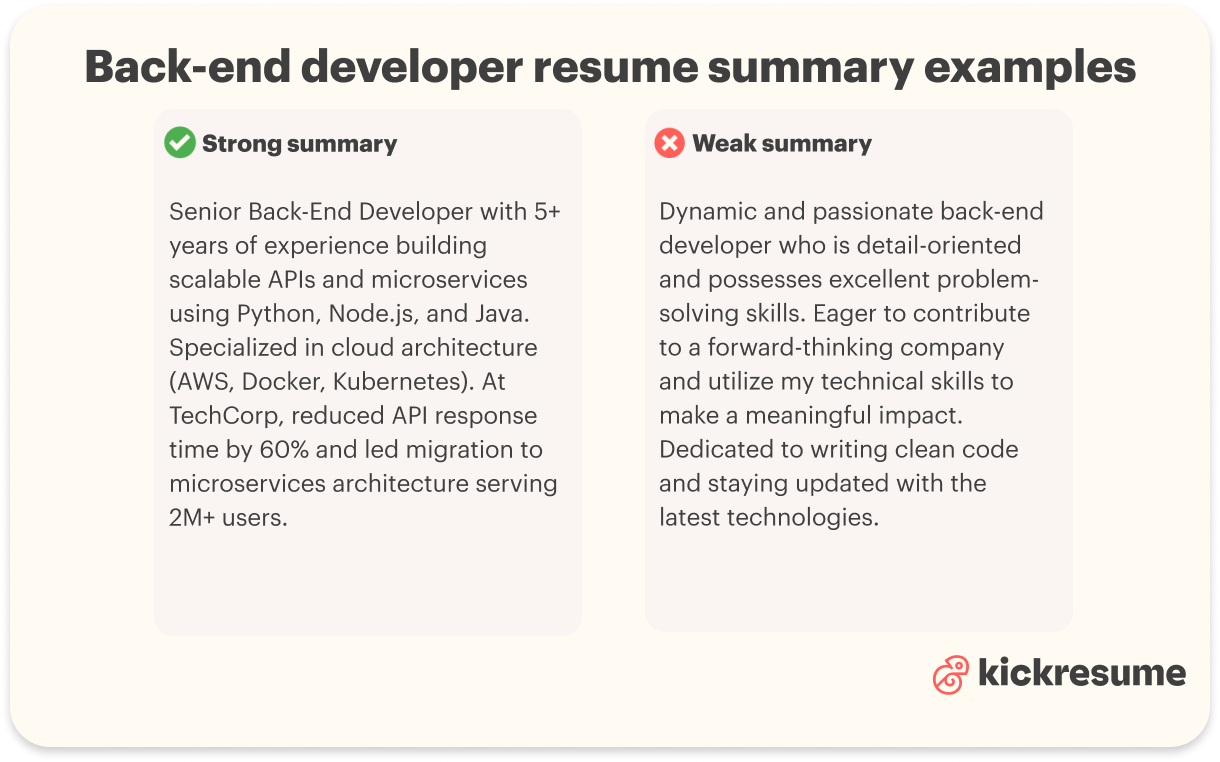
Bad Back-end developer resume example
Dynamic and passionate back-end developer who is detail-oriented and possesses excellent problem-solving skills. Eager to contribute to a forward-thinking company and utilize my technical skills to make a meaningful impact. Dedicated to writing clean code and staying updated with the latest technologies.
What makes this example so weak? This example is a one big nothing burger. It uses phrases that sound professional and significant, but when you think about what they actually mean, you'll understand that this summary says nothing of substance.
Good Back-end developer resume example
Senior Back-End Developer with 5+ years of experience building scalable APIs and microservices using Python, Node.js, and Java. Specialized in cloud architecture (AWS, Docker, Kubernetes). At TechCorp, reduced API response time by 60% and led migration to microservices architecture serving 2M+ users.
Why does this work? Because it mentions specific, in-demand technologies (Java, Python, microservices) right away. It backs up claims with a concrete metric (60% reduction in API response) instead of vague statements. It also hits core back-end priorities like building scalable APIs and cloud architecture in a compact way.
When to choose resume objective
A resume objective is a better choice if you’re early in your career, changing careers, or applying for your first back-end developer role.
Unlike a summary, which highlights proven experience and results, an objective focuses on:
- What role you’re targeting
- What skills you already have
- How you plan to add value as you grow
That said, many resume objectives fail because they talk only about what the candidate wants and not what they bring to the employer.
Let’s look at what not to do first.
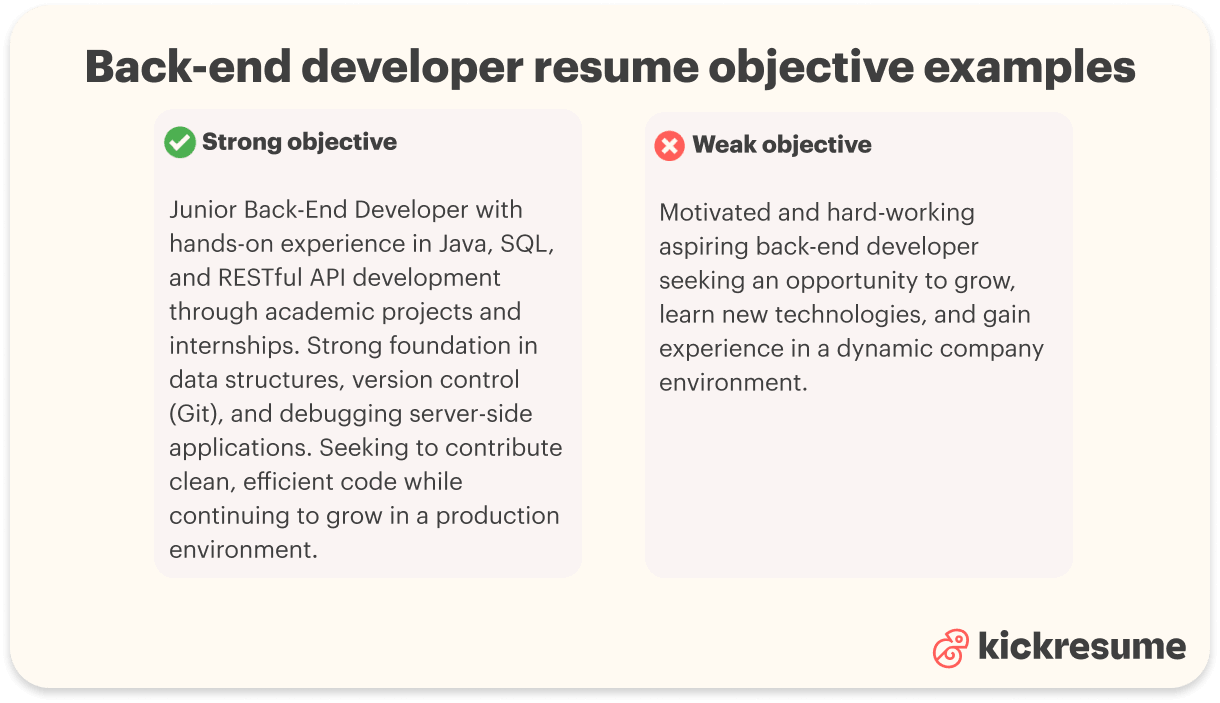
Bad back-end developer resume objective example
Motivated and hard-working aspiring back-end developer seeking an opportunity to grow, learn new technologies, and gain experience in a dynamic company environment.
Why does this objective fall short? This objective is entirely employer-neutral. It doesn’t mention any technologies, any relevant skills, or any indication of readiness for a back-end role. Phrases like “motivated,” “hard-working,” and “seeking an opportunity” are overused and don’t differentiate the candidate from hundreds of others. Most importantly, it focuses on what the applicant wants, not what they can contribute.
Good back-end developer resume objective example
Junior Back-End Developer with hands-on experience in Java, SQL, and RESTful API development through academic projects and internships. Strong foundation in data structures, version control (Git), and debugging server-side applications. Seeking to contribute clean, efficient code while continuing to grow in a production environment.
Why does this work? This objective immediately signals role alignment (“Junior Back-End Developer”) and lists specific, relevant technologies. It shows that the candidate already has practical exposure, even if only through projects, and understands core back-end concepts like APIs and version control. Instead of vague ambition, this example communicates direction and value.
A persuasive back-end developer resume objective follows these rules:
- Name the role you’re targeting. Avoid generic labels like “developer” or “programmer.”
- Mention specific technologies. Even basic familiarity with languages, frameworks, or databases matters.
- Reference real experience. Academic projects, internships, bootcamps, or personal projects all count.
- Balance learning with contribution. Show that you want to grow and help the team succeed.
A strong objective reassures hiring managers that while you may lack experience, you don’t lack preparation or potential.
3. Highlight your back-end development hard (and soft) skills
As a back-end developer, you rely on specific technical skills to perform your job. Naturally then, hiring managers pay a lot of attention to the skills section of your resume.
While creating the skills section, don't just include every single skill/tool/software you've ever touched. Instead, you want to add skills that align with what the company is searching for.
You can do so by researching the job description and tailoring your resume around the specific programming languages, systems, and programs they want.
Best hard skills to include in your back-end developer resume
- Back-end programming languages: Python, PHP, Java, C#
- Back-end framework: ASP.NET Core, Spring Framework
- Front-end programming languages: HTML, CSS, JavaScript, Typescript
- Front-end framework: Angular, React Native, WPF
- Mobile framework: Xamarin
- Operational routing APIs: Toutific, OnFleet
- Databases: Oracle, MSSQL, MySQL
- Version control: Git, TSF
- Cloud services: AWS, Azure
- Security compliance
- DevOps
- Docker, Kubernetes
Plus, you shouldn't completely ignore soft skills in your back-end developer CV.
Best soft skills to put on your back-end developer resume
- Communication. Effective communication helps back-end developers collaborate with team members and explain technical concepts to non-technical colleagues.
- Creativity. Creative thinking allows developers to find innovative solutions and enhance application functionality, improving user experiences.
- Adaptability. Tech landscape is rapidly evolving; hence it's crucial for back-end developers to stay up-to-date with new tools, languages, and frameworks.
- Problem-solving. Strong problem-solving skills help developers quickly identify and address code issues, maintaining project success and efficiency.
- Teamwork. Back-end developers often collaborate with front-end developers, designers, product managers, and other stakeholders throughout a project's lifecycle.
Our tip is to only add skills you know in-depth and that you’re comfortable discussing in an interview. But if you feel it’s important to also list some other technologies, you can divide your skills section into “Key skills” and “Other technologies”.
4. Describe your back-end work experience with specific and quantifiable details
But simply listing your tech stack is not enough.
Every other candidate applying for that role also knows Python. A good chunk of them have worked with PostgreSQL, touched AWS, and built REST APIs. So if your work experience section is just a list of technologies and vague tasks, you're not giving the hiring manager anything to grab onto.
What actually gets attention is showing what you did with those tools and what happened because of it.
What a strong back-end developer work experience entry looks like
A solid entry covers the basics (job title, company, dates) but it also has to describe the following:
- What you built or worked on
- The technology or approach you used
- The outcome or impact, ideally with a number attached
Take a look at these two examples and see for yourself:
Bad back-end developer work experience example
Back-End Developer TechCorp | 2021–2024
- Responsible for developing APIs
- Worked on database optimization
- Helped with deployment and CI/CD pipeline
- Fixed bugs and performance issues
Why doesn't this work? Honestly, it could describe literally anyone. There's no scale, no context, no result. The recruiter learns that you've touched these things, but not whether you were any good at it, or whether it mattered. "Responsible for developing APIs" tells them nothing about the APIs, the load they handled, the team involved, or what problem they solved.
Good back-end developer work experience example
Back-End Developer TechCorp | 2021–2024
- Built and maintained RESTful APIs handling 2M+ daily requests, with an average response time under 120ms
- Optimized PostgreSQL queries across a legacy reporting module, cutting average load time from 8 seconds to under 1
- Migrated a monolithic Node.js application to microservices on AWS, reducing infrastructure costs by 30%
- Set up GitHub Actions CI/CD pipeline that reduced deployment time from 45 minutes to under 8
- Mentored two junior developers through code reviews and pair programming sessions
Why does this land? Every bullet tells a small story. You can see the scale of the work, the approach, and what changed because of it. Numbers make it specific and more impactful. Even the mentoring bullet is specific: "two junior developers" tells recruiters more than "supported the team."
What back-end developers can actually quantify (more than you think)
A lot of devs freeze here because they think they don't have the right kind of numbers. But back-end work is full of quantifiable stuff. He are just a few examples:
Performance and scale
This is the most obvious category and also the most impressive to a hiring manager.
- Requests per second or daily active users your system handled
- API response times before and after your work
- Query optimization improvements (load time, execution time)
- Uptime percentages or reduction in downtime incidents
Infrastructure and cost
If you touched cloud architecture, deployments, or server configuration, there's almost always a number in there.
- Cost reduction from migrations or infrastructure changes
- Server count reduced through containerization or consolidation
- Storage or memory footprint improvements
- CI/CD pipeline speed improvements
Codebase and reliability
These are easy to overlook but matter a lot to teams thinking about long-term maintainability.
- Test coverage percentage you brought in or increased
- Bug reduction or incident frequency improvement
- Code review throughput if you led a team
- Tech debt items resolved or deprecated services retired
Team and delivery
Even if you weren't a lead, you can still show impact on the people and processes around you.
- Number of developers you mentored or onboarded
- Sprint delivery rate or ticket throughput improvements
- Documentation you wrote that's now used by the whole team
- Cross-team integrations you led or contributed to
How to structure your back-end developer experience section
A few simple rules make this section easier to read and more effective:
- Use 3–5 bullet points for recent roles
- Use fewer bullets for older positions
- Focus on the last 10–15 years of experience
- List jobs from most recent to oldest
- Prioritize relevance over completeness
And one more thing: tailor it! If the job posting is heavy on distributed systems, lead with your distributed systems work. If they care about API design, put that front and center. The experience section is an argument for why you're the right person for this specific role. Make sure it reads like one.
5. Create a custom personal projects section
Naturally, your resume should include standard resume sections, like:
But if you want to get noticed, you need to give hiring managers something extra.
Adding personal projects section to your CV can help you do just that, plus it will make you a more qualified candidate. Some even say this section is a must-have for people looking for a back-end developer position.
And which projects can you include in a section like that? It can be a blog, a mobile app, or a personal website — really anything programming-related that you created by yourself and in your own time.
It will show the hiring manager your passion for programming — and hiring managers love that!
Just create a separate section called “Side projects” or “Personal projects” and include:
- Name of each project
- Short description
- Tools and technology you used
- Respective links
By the way, if you're bound by an NDA and cannot really talk about your past projects, there's still a way to include those projects in your resume. Our resume vs non-disclosure agreement guide can help.


 See more examples like these
6. Include your back-end developer courses and certificates
This section is a great place to let the hiring manager know you’re someone who likes to stay up to date with new softwares and programs.
Jot down relevant courses and new cloud-based certificates either in the education section or in a separate section called “Courses & Certificates” (in case you have more than 2 of them).
List your certificates in reverse chronological order, beginning with the most recent one.
Don’t forget to include:
- Name of the certification
- Dates
- Authority
- URL or code for the online badge
Don't have any certificates under your belt yet? The following back-end developer courses and certificates might just be the missing pieces in your professional jigsaw puzzle:
- IBM Full Stack Cloud Developer: IBM's professional certification navigates through essential technologies like Node.js, Express, React, Redux, and databases.
- Java Programming and Software Engineering Fundamentals by Duke University: A surefire way to bolster your Java skills, this comprehensive course takes you from basic syntax to data structure.
- Back-End Web Development Certificate at General Assembly: Hands-on and immersive, it covers everything from Python, Django to data modeling.
- Oracle Certified Professional, Java SE 8 Programmer: This globally recognized certification will drastically improve your credibility and employability as a back-end developer.
Scoop up these courses and certificates, grow your back-end skills, and start coding your success story. Now that's what we call a back-end boost!
7. Education section tips for young developers
For young back-end developers who may be lacking significant work experience, your education section can play a vital role in showcasing your skills, passion, and potential.
Here are some tips to enhance your education section and make it stand out to potential employers:
- Highlight relevant coursework. Mention any courses or workshops relevant to back-end development, such as programming languages, data structures, algorithms, or web application development.
- Include school projects. Showcase your hands-on experience by listing school projects that demonstrate your coding abilities, problem-solving skills, and familiarity with development tools. Briefly describe the project, the technologies used, and any notable achievements.
- Showcase internships and hackathons. Including internships, hackathons, or coding competitions can demonstrate your initiative and practical experience. These experiences show employers that you can apply your skills in real-world situations.
- Describe your thesis. Show your in-depth understanding of a specific topic and the tools you used. Highlight if your thesis project was picked up by a third party or company and is now being used in real-world applications, demonstrating the practical relevance of your work.
Find out your resume score!

8. Tailor your resume for specific job ads
One key factor in making your back-end developer resume successful is tailoring it for each job application. A simple, yet effective trick.
Customizing your resume can significantly increase your chances of landing an interview, as employers can easily see the connection between you and the role.
Plus, it helps get you through applicant tracking systems (ATS) that may be used to scan resumes.
Here's how to tailor your resume using keywords and other elements from the job description:
- Analyze the job description. Carefully read the job ad, taking note of the required technical skills, qualifications, and other attributes mentioned by the employer. Look for specific keywords and phrases that stand out and are repeated throughout.
- Match your skills and experience. Review your resume to ensure it highlights the same skills and qualifications mentioned in the job description. Swap out or rephrase your skills to match their terminology.
- Incorporate keywords throughout your resume. Use the identified keywords strategically throughout your resume, including your summary, skills, and experience sections.
9. Link your GitHub
GitHub is very similar to LinkedIn for technical roles. Don't panic, we're not saying they're the same.
What we mean is that most of the hiring managers will either look your GitHub up or ask for it anyway. Just like they look at LinkedIn profiles.
Apart from getting noticed and showing off your programming skills, a GitHub profile is a great way to show off attributes that simply cannot be conveyed through your resume.
For instance, it shows you know:
- how to write a clean code;
- that you can read code;
- and that you have great collaboration skills.
And how to include GitHub on your resume? Simply put a link to your best GitHub project at the very top of your resume, right next to your contact details.
Don't forget to set up your repositories to showcase your best work, as employers may browse through your projects.
Lastly, only put GitHub on your resume if you deem it as your advantage.
10. Common resume mistakes back-end developers should avoid
Even strong developers get passed over because of resume issues that have nothing to do with skill level.
Before sending your resume, run through this checklist. It can save you from avoidable rejections.
#1 Treating typos as “minor”
Small errors stand out more on technical resumes. A single misspelled framework or inconsistent capitalization can make you look careless.
#2 Turning your skills section into a keyword dump
A long wall of technologies doesn't explain your strengths or accomplishments. Recruiters can't tell if you used a tool once or relied on it daily.
#3 Writing experience that could belong to anyone
If your job description could fit any back-end developer, it's not doing its job.
#4 Leaving impact out of the story
Many resumes stop at “what I did” and never get to “why it mattered.”
#5 Missing the language recruiters are scanning for
Applicant tracking systems don't infer meaning. If your resume does not reflect the wording of the job posting, it may never be seen.
#6 Overselling your tech stack
Listing every tool you have heard of can create unrealistic expectations during interviews.
#7 Forgetting that back-end work is collaborative
Purely technical resumes often ignore communication and teamwork, even though they matter in daily development work.
#8 Making your resume hard to scan
Recruiters don't read resumes line by line. They scan. And they scan pretty fast. If the layout is messy, key information gets missed.
#9 Including content that adds no value
Extra information can dilute your message and push important details further down the page.
A well-written resume guides the reader to understand it quickly. Avoiding these common mistakes helps your back-end developer resume do exactly that.
11. Pair your back-end developer resume with a tailored cover letter
A bullet point might say that you redesigned an API and cut response times by 40%. Your cover letter can tell the reader why the problem mattered, how you approached it, and what made you choose one solution over another.
In other words, don't use the extra page to repeat your resume. Add something new.
What should a back-end developer cover letter include?
A back-end developer cover letter needs to give the recruiter a good idea of:
- why this particular back-end role interests you;
- which parts of your experience match what they're building;
- what kinds of technical problems you enjoy solving;
- how you've contributed to a development team beyond simply writing code;
- and why you want to work for this company specifically.
Give your technical experience some context
Your resume needs to be concise, which means a lot of interesting detail gets cut.
The cover letter doesn't have that problem.
For example, if your resume says you migrated a monolithic application to microservices, your letter could briefly explain the challenge that prompted the migration and what you personally owned during the process.
You can also use this space to talk about things that don't translate neatly into resume bullets, such as mentoring junior developers, working through a difficult production issue, collaborating with front-end engineers, or learning an unfamiliar technology because a project needed it.
Let your cover letter write itself — with AI!

Software Engineering Career Outlook in 2026
Employment in Software Engineering / Software Development is projected to grow by 15% between now and 2034, which is way faster than the national average for all occupations. For reference, the average growth across all careers is 3%. (Source: U.S. Bureau of Labor Statistics).
This growth will result in approximately 129,200 software engineering job openings each year throughout the decade.
However, with AI in the mix, the career outlook for software engineers in 2026 will continue to be mixed:
- Demand for software engineers who can build, deploy and maintain AI systems still outpaces supply. This includes roles focused on LLM integration, prompt engineering, fine-tuning models, and building RAG systems.
- However, entry-level software engineering jobs will remain vulnerable in 2026 as AI tools automate routine coding and troubleshooting.
- Plus, tech layoffs also continue into 2026.
According to Gartner, generative AI will require 80% of the software engineering workforce to upskill through 2027.
Average US base salaries across popular Science roles:
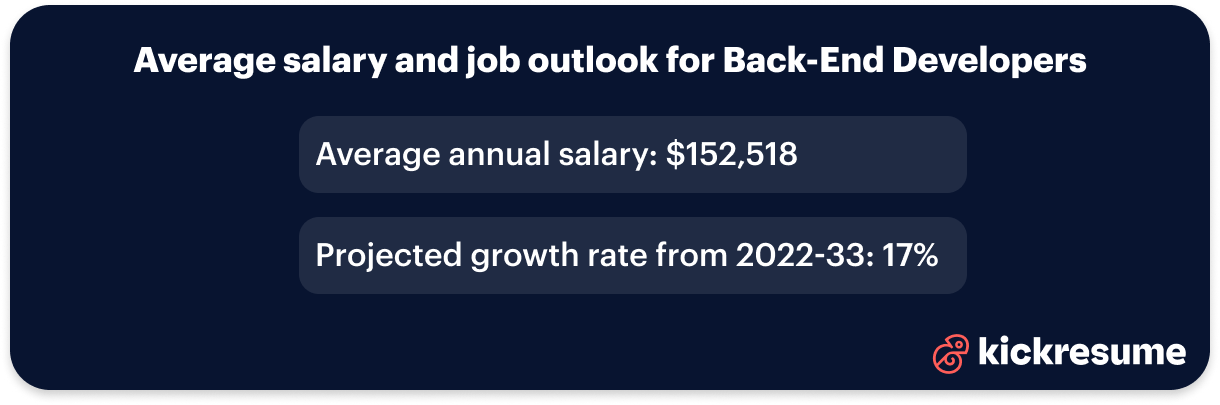
- Back-end Developer: $153,325/year
- Front-end Developer: $121,087/year
- Software Engineer: $130,446/year
- Junior Tester: $69,915/year
- UX Designer: $121,624/year
- Web Developer: $81,901/year
- Prompt Engineer: $98,161/year
- AI training specialist: $51,884/year
These salary figures come from Indeed's January 2026 data, including anonymous user submissions and job postings. Your actual earnings will vary based on where you work, company size, role type, and your level of experience.
All in all, if you’re thinking about starting a career in Software Engineering/Development or advancing within the field, now is a great time to look into the opportunities available in this industry.
Back-End Developer / Engineer Resume FAQ
Should I include all programming languages I know on my back-end developer resume?
Focus on relevant languages to the job you're applying for. However, showcasing a broad repertoire can display your versatility.
How should I present my coding projects in my resume?
Make a separate section for projects. Mention the project name, the programming languages used, your role, and the project outcomes or learnings.
I am a self-taught back-end developer. How should I present this in my resume?
Highlight the programming languages and frameworks you've mastered, projects you've worked on, and any relevant certificates you've earned. Self-study can show initiative and drive!
Should I use a skills-based format for my back-end developer resume?
If your work experience isn't linear or if you're changing careers, a skills-based resume could work well. It emphasizes your skills over chronological work history.
I kept up to date through online courses. Should I include them in my education section?
Absolutely! Lifelong learning is valued in tech industries. Make a 'Continuous Learning' or 'Professional Development' section to showcase these courses.



![Software Developer [swedish] Systemutvecklare](https://d1xn1bcogdo8ve.cloudfront.net/119/thumbnail.webp)


![Webmaster/webmestre Resume Example [FR]](https://d1xn1bcogdo8ve.cloudfront.net/164/thumbnail.webp)


![Webmaster/webmestre Cover Letter Example [FR]](https://d1xn1bcogdo8ve.cloudfront.net/139/thumbnail.webp)


![How to Write a Professional Resume Summary? [+Examples]](https://d2xe0iugdha6pz.cloudfront.net/article-small-images/How_to_Write_a_Professional_Resume_Summary_.png)

![How to Describe Your Work Experience on a Resume? [+Examples]](https://d2xe0iugdha6pz.cloudfront.net/article-small-images/How_to_Describe_Your_Work_Experience_on_a_Resume_.png)